

From Planning to Execution:How to Keep Your Team Accountable All Year
By Eloiza Mariano Serate
I’ve seen this pattern more times than I can count. A startup founder starts the year strong, the team is motivated, goals are clear, and everyone swears this is the year operations will finally feel “under control.” Then March hits. Deliverables slip. Updates get vague. You start hearing, “I thought someone else owned that.”
As an agency owner and Fractional COO, I’ve learned something the hard way: accountability doesn’t come from motivation. It comes from design. Here’s how I build a simple accountability system that actually holds up all year, especially for remote teams, and how we use ClickUp to make it stick.
The year I stopped trusting “check-ins”
Early on, I relied on the usual stuff: daily chats, weekly check-ins, “quick calls,” and hoping adults would act like adults. But when you’re building fast, hoping is expensive.
One founder I supported had a small remote team and a big vision. The team was talented, but deadlines kept moving. Tasks were “almost done” for days. The founder was constantly following up, and ironically, that follow-up became the system. If they didn’t ping people, nothing moved.
That’s the moment I realized: if the leader is the workflow, the business will always bottleneck at the leader.
So we rebuilt their execution rhythm using a few non-negotiables.
Accountability starts with clarity, not pressure

Most “accountability problems” are really clarity problems.
If you want your team accountable, make sure these are true for every piece of work:
● Someone is clearly the owner. Not “assigned,” not “tagged,” not “included.” Owner means they drive it to done.
● “Done” is defined. Not vibes. Not “finish it.” It’s a clear outcome someone else can verify.
● The due date matches reality. If everything is urgent, nothing is.
This is where ClickUp becomes a game changer, especially for startup founders who are tired of juggling Slack, spreadsheets, and memory.
In ClickUp, we set a task owner, a due date, and a definition of done inside the task description. We attach files, links, and SOPs there too. One place. One source of truth. When the team asks, “Where is it?” you can say, “Check ClickUp.”
Not to be harsh, but to be consistent.
The “accountability loop” that keeps momentum all year
Accountability isn’t a meeting. It’s a loop.
Here’s the loop I build as a Fractional COO, and yes, it’s simple on purpose:
● First, we plan work in small cycles. Weekly planning beats monthly planning for most startups because things change fast. In ClickUp, we set weekly priorities and keep the list tight. If it’s not a priority, it doesn’t get scheduled.
● Second, we track execution daily without micromanaging. I like lightweight daily updates that answer three questions: What did you finish? What’s next? What’s blocked? You can do this inside ClickUp comments so updates stay tied to the work.
● Third, we review results weekly. Not a long meeting. A real operations review. What moved, what didn’t, and why. The goal is not to blame. The goal is to improve the system.
If you do this consistently, your team stops performing for the check-in and starts performing for the outcome. That’s the shift.
The “accountability loop” that keeps momentum all year
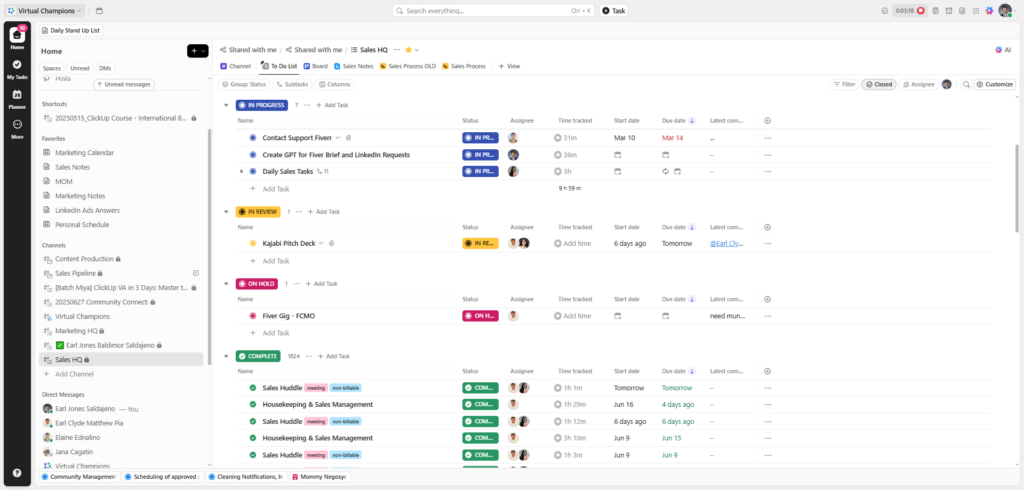
Remote teams fail when work becomes invisible.
In ClickUp, we usually create views that match how leaders actually think:
● A CEO view that shows top priorities, deadlines, and blockers.
● A team view that shows each person’s workload and what’s due this week.
● A simple dashboard that highlights overdue tasks and items waiting on approval.
When visibility is built in, you don’t need to chase updates. The system shows you what needs attention.
Also, visibility protects your good team members. High performers get burned out when underperforming work is hidden. A transparent system makes effort visible and gaps obvious, without drama.
The agency lesson: measure what matters, not everything
As an agency owner, I learned that teams don’t become accountable because you track more. They become accountable when you track the right things.
Pick a few scorecards that reflect outcomes, not activity. Examples: turnaround time, number of revisions, client response time, lead follow-up speed, inbox zero by end of day. Keep it minimal.
Then connect those scorecards to tasks and routines inside ClickUp. This is how accountability becomes normal. Not emotional.
When you need more than a tool
ClickUp is powerful, but tools won’t fix a system that doesn’t exist.
If your team still misses deadlines even with software, the real problem is usually one of these:
● Roles are unclear.
● SOPs are missing.
● Workload is unrealistic.
● Leadership is reacting instead of running a cadence.
That’s exactly where Fractional COO support helps. We don’t do bandaid solutions, we build systems. And when you pair that with professional virtual assistant support, you free up founder time while keeping execution tight.
Accountability is a leadership gift

Accountability isn’t about being strict. It’s about being kind enough to create a clear structure your team can succeed in.
If you want to keep your team accountable all year, build clarity, create a rhythm, and make work visible. Use ClickUp as your operating system, not just a task list.
And if you want help setting up an accountability system, or you’re ready to hire a VA team with real operational support behind it, contact us at Virtual Champions PH. You can also inquire about Fractional COO support if you want to scale without the chaos.
Accountability becomes sustainable when it is built into your operations, not left to reminders and follow ups. Through our Virtual Assistant Services, we provide structured execution support that keeps priorities moving, deadlines visible, and leaders out of daily bottlenecks. If you are ready to scale with a team that understands systems, rhythm, and ownership, this is where execution starts to feel lighter.
If you need the structure behind that execution, our ClickUp Consulting and Implementation service helps you design a workspace that reinforces clarity and real accountability. Let’s build a system that supports your leadership and keeps your team aligned all year long by taking the next step and contact us. Because when accountability is designed well, growth stops feeling chaotic and starts feeling controlled.
Want to hear the latest news about Virtual Champions PH?
This could be the start of something awesome! Subscribe to our newsletter. Stay updated with exclusive tips, articles, new product tools and notifications, as well as special service offers from VCPH conveniently in your inbox!
