

The Hidden Cost of Broken Processes:
7 Signs Your Business Needs an Operations Reset
By Eloiza Mariano Serate

Most businesses do not wake up one morning with broken operations.
It happens gradually.
A workaround becomes the normal way of doing things. One person becomes the only person who knows how a process works. A weekly meeting gets added because nobody knows the status of anything. Someone creates another spreadsheet.
The founder steps in to fix a problem “just this once.”
Then does it again next week.
Eventually, the business is still moving, but it takes far more effort than it should.
That is the hidden cost of broken business processes.
Many business leaders normalize these problems. They assume they need better employees, another hire, or a new tool.
Often, the real issue is simpler:
The process was never designed to support the business at its current size.
Before you add more people, platforms, or automation, it may be time for an operations reset.
What Does an Operationally Healthy Business Look Like?
Healthy business operations do not mean everything runs perfectly.
Problems will still happen, clients will change their minds, employees will make mistakes, and priorities will shift.
The difference is that the business does not depend on constant intervention to keep moving.
In an operationally healthy business:
People know what they own.
Work moves through clear stages.
Important information has a defined home.
Routine tasks follow repeatable processes.
Handoffs are clear.
Leaders can see progress without chasing updates.
Problems can be identified before they become emergencies.
Most importantly, the founder is not the default solution every time something goes wrong.
If that does not describe your business right now, these seven signs can help you identify where your operational efficiency may be breaking down.
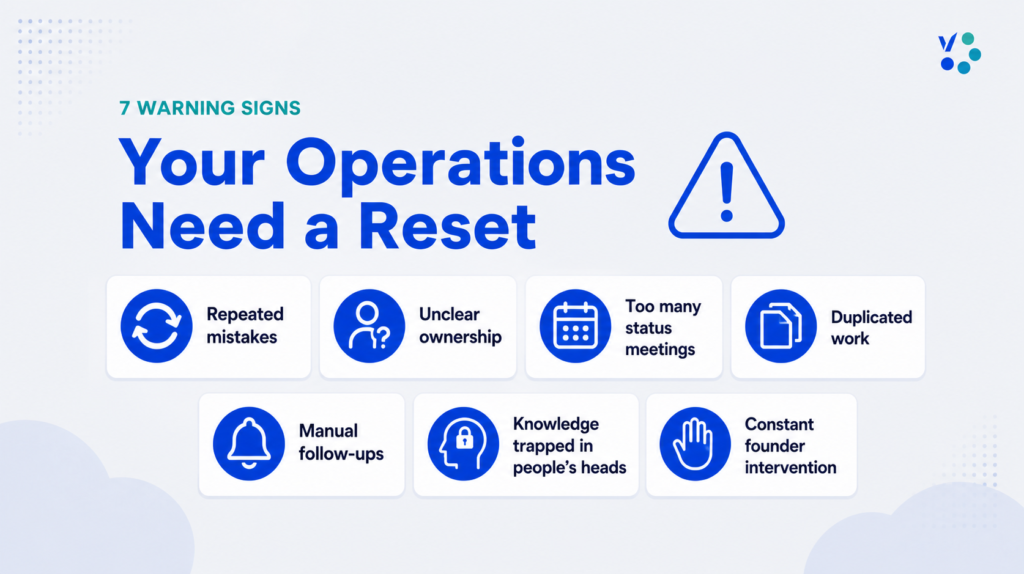
1. Repeated Mistakes Reveal Broken Business Processes
A mistake happens once, you correct it.
It happens twice, you remind the team.
It happens five times, and you start wondering whether you have a people problem.
Maybe.
But repeated mistakes are often evidence of a process-design problem.
If different people keep making the same mistake, look beyond the individual.
Is the expected outcome clear?
Is there a checklist?
Is the right information available when the person needs it?
Is there a quality-control step?
Does anyone actually own the process?
Correcting the employee may solve today’s mistake.
Improving the process helps prevent tomorrow’s.
2. Unclear Ownership Creates Operational Bottlenecks
Listen for phrases like:
“I thought she was doing it.”
“I wasn’t sure if that was mine.”
“I was waiting for approval.”
“I didn’t know I needed to follow up.”
These may sound like communication problems.
Usually, they are ownership problems.
When responsibility is unclear, tasks sit untouched until someone notices. The business then compensates with reminders, meetings, follow-ups, and founder intervention.
Clear ownership should answer three basic questions:
Who owns this? What does done look like? When does ownership transfer?
If your team cannot answer those questions, the process is not clear enough.
3. Too Many Status Meetings Signal Poor Operational Visibility
Meetings are not automatically bad.
But excessive status meetings can signal poor operational visibility.
If you need a meeting just to discover what has been completed, what is delayed, who owns the next step, or where a project stands, your operating system is not giving people the information they need.
The meeting has become the system.
Healthy operations use meetings for decisions, problem-solving, strategy, and collaboration.
Your team should not need to reconstruct the entire week just to understand what is happening.
4. Duplicated Work Is Quietly Reducing Operational Efficiency
Duplicated work is one of the easiest operational costs to miss.
Someone updates the CRM.
Then someone updates a spreadsheet.
Then the same information gets posted in Slack.
Then leadership asks for another report because they still cannot see what they need.
Each action may take only a few minutes.
Multiply those minutes across your team, clients, and an entire year.
Suddenly, the “small” inefficiency becomes expensive.
Whenever information is manually entered, copied, reformatted, or reported in multiple places, ask:
Why does this step exist?
Sometimes there is a valid reason.
Sometimes nobody has questioned the workflow in years.
Effective workflow optimization starts by identifying unnecessary work before trying to automate it.
5. Manual Follow-Ups Are a Sign Your Business Needs a Process Reset
Someone has to remember to follow up with the lead.
Someone has to remember to send the onboarding form.
Someone has to check whether the client responded.
Someone needs to remember the approval.
Someone needs to move the task forward.
When routine follow-ups depend entirely on human memory, things will eventually fall through the cracks.
This is where good process design and rules-based automation can help.
If a predictable event should always trigger a predictable action, the system should help make that happen.
Your team’s attention should be spent where judgment matters, not on remembering repetitive administrative tasks.
6. Important Business Knowledge Is Trapped in People's Heads
Ask yourself an uncomfortable question:
If one key person disappeared for two weeks tomorrow, what would stop working?
If the answer is “a lot,” you have identified operational risk.
Maybe only one person understands a client’s preferences.
Maybe the founder knows the pricing logic.
Maybe one employee understands the reporting process.
Maybe someone maintains a personal spreadsheet nobody else knows exists.
Expertise is valuable.
Dependency is dangerous.
When essential information lives only inside individuals’ heads, the business creates single points of failure.
Strong business process documentation, shared systems, and clear workflows turn individual knowledge into organizational knowledge.
7. Constant Founder Intervention Means Your Operations Cannot Scale
This may be the biggest warning sign.
The founder reviews every deliverable.
The founder handles exceptions.
The founder answers process questions.
The founder follows up on missed deadlines.
The founder resolves client issues.
The founder knows where everything is.
At first, this can feel responsible.
Eventually, it becomes an operational bottleneck.
If work repeatedly stops until the founder gets involved, do not immediately assume the team needs more training.
Ask what they are missing.
Context?
Decision rights?
A documented process?
Clear standards?
Access to information?
Ownership?
Founder dependency is often an operational design issue disguised as a leadership requirement.
People Problem vs. Process Problem: How Can You Tell the Difference?
Sometimes there genuinely is a performance issue.
But before deciding that someone is the problem, examine the system around them.
Ask:
Could a capable person reasonably succeed inside this process?
If expectations change depending on who asks, ownership is unclear, information is scattered, and the process exists mainly inside the founder’s head, replacing the employee may simply give the next person the same problem.
A strong employee cannot permanently compensate for a weak system.
People need clear processes to perform consistently.
That is why business process improvement should often come before adding more headcount.
Why Adding More Tools Does Not Fix Broken Business Operations
When operations feel messy, buying software can feel like progress.
A new CRM.
A new project management platform.
A new automation tool.
A new AI tool.
But technology does not create clarity by itself.
A tool can support a good process.
It can also make a bad process more complicated.
Before adding technology, understand the workflow.
What triggers it?
Who owns it?
What happens next?
Where does information live?
Where are the handoffs?
Where are the delays?
What requires judgment?
What is repetitive enough for rules-based automation?
Fix the process first. Then choose the technology that supports it.
How Broken Handoffs Create Hidden Operational Costs
Many operational problems happen between tasks, not inside them.
Sales closes the client, but who tells operations?
Operations completes onboarding, but who confirms delivery can begin?
The team finishes the work, but who tells finance to invoice?
A client requests a change, but where is that decision recorded?
Every handoff creates an opportunity for information to disappear, work to stall, or responsibility to become unclear.
The result is hidden operational costs:
Lost time. Delayed delivery. Rework. Missed opportunities. Frustrated employees. Inconsistent customer experiences.
And founder attention.
That last one may be the most expensive.
How to Run a Simple Operations Reset Assessment
Before your next growth cycle, choose one important workflow and follow it from beginning to end.
Ask:
Where does it start?
Who owns each stage?
Where does work wait?
Where are people entering information more than once?
Which steps depend on memory?
Where does information get lost?
Where does leadership have to step in?
Which problems keep repeating?
Do not map how the workflow is supposed to happen.
Map what actually happens.
That gives you your baseline.
Then design the better version.
What Should You Fix First During an Operations Reset?
Do not try to rebuild your entire operation at once.
Start where the friction is frequent and expensive.
Look for a process that happens often, touches multiple people, creates repeated mistakes, or regularly pulls leadership back into execution.
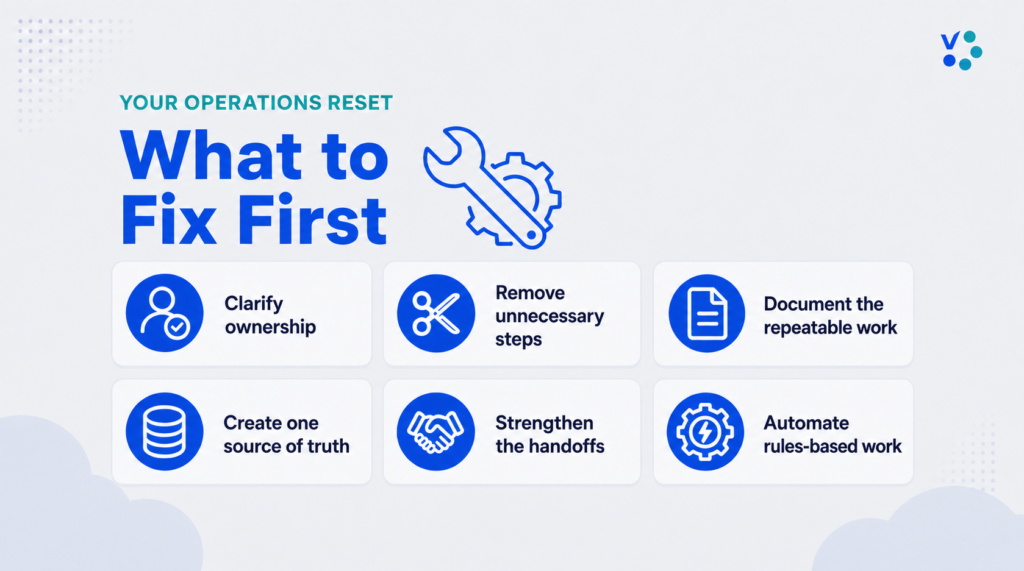
Then fix the basics.
Clarify ownership.
Remove unnecessary steps.
Document the repeatable work.
Create one source of truth.
Strengthen the handoffs.
Automate predictable, rules-based work where appropriate.
Measure whether the new process actually works.
Then move to the next one.
An operations reset is not about making your business more complicated.
It is about removing the complexity your team has learned to live with.
If your business is growing but every new client, project, or team member creates more pressure on leadership, do not automatically add another person or another tool.
Diagnose the process first.
The inefficiencies you normalize today can become the operational bottlenecks you fight during your next stage of growth.
Q4 is an opportunity to stop carrying them forward.
Ready to identify what’s slowing your business down?
Start your Operations Reset with Virtual Champions PH and book a strategy call to identify where your people, processes, and systems are creating unnecessary friction.
Want to hear the latest news about Virtual Champions PH?
This could be the start of something awesome! Subscribe to our newsletter. Stay updated with exclusive tips, articles, new product tools and notifications, as well as special service offers from VCPH conveniently in your inbox!
