

How to Build an Agency That Runs Without You: The HBMS Framework
By Eloiza Mariano Serate

Every founder eventually reaches an uncomfortable point in growth.
From the outside, the business looks healthy. Revenue is moving. Clients are coming in. The team is busy. The tools are in place. Underneath it, the agency is running on its owner instead of on an agency operating system.
Too many decisions route through one person. Too much context lives in one head. The team can move, but only until they hit something that needs the founder to step back in. That is the founder bottleneck, and most agency owners overwhelmed by operations do not see it clearly until something breaks.
I know because I lived it.
The Week My Agency Fell Apart
September 2023. I was in Dubai on a two-month build for a major company. In the same handful of days, the person I trusted most went quiet and let go of the rope. Every project I had left with him stopped. A client relationship I had been holding together by will came apart, and I sat on the edge of a hotel bed saying “I take full responsibility” on a loop, eight thousand kilometres away, watching it fall through my hands through a screen.
And a dear aunt of mine died, and I could not go home. My husband was at sea. My family grieved, scattered across the planet.
I had built something that could not survive me stepping away for a single week. The price was not a lost client. The price was that I could not be present for the people I was working to provide for.
That week is why HBMS exists. A business should run on a system, not solely on its owner. Providing for your family and being present for them should not have to be opposites.
What the HBMS Framework Is (And What It Is Not)
HBMS stands for Heart, Body, Mind, and Soul. It is an operating system for agency owners who became the bottleneck in their own business.
The Four Layers of HBMS
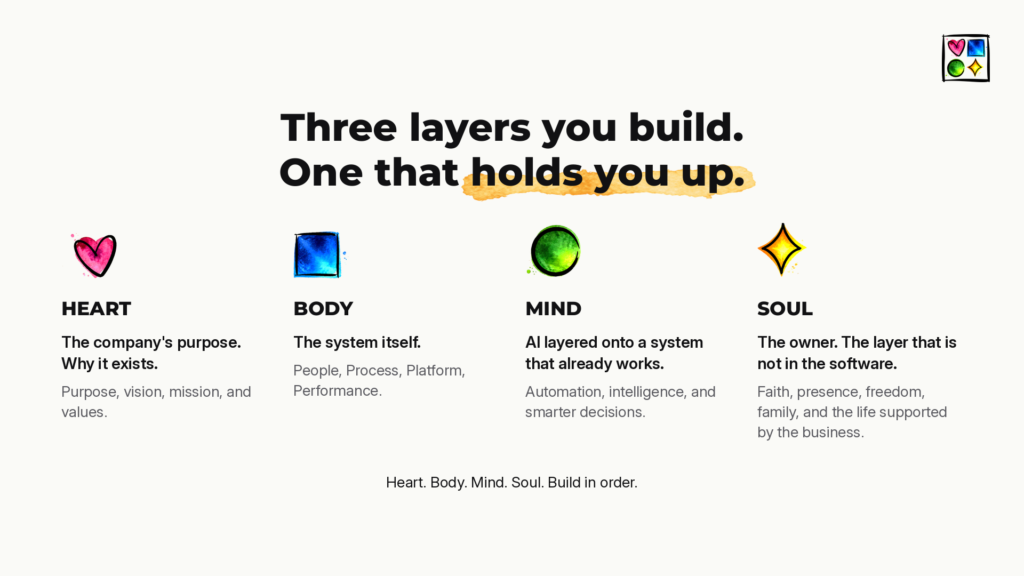
Three layers you build. One that holds you up.
Heart (Puso): the company’s purpose. Why it exists.
Body (Katawan): the system itself. People, Process, Platform, and Performance.
Mind (Isip): AI layered onto a system that already works.
Soul (Kaluluwa): the owner. The layer that is not in the software.
What HBMS Is Not
It is not a wellness framework. It is not a motivational programme. It is a map of what makes a business stable enough to grow without making the founder its permanent operating system.
Founders name the problem in different ways. “We need better delegation.” “We need stronger systems.” “We need better people.” “We need to use AI.” Often, all of those are true.
But they cannot be built in random order. That is the whole point of the framework.
Heart: Why Your Agency Exists and Why It Matters for Every Decision
Heart is the company’s purpose: why the business exists, who it serves, what it is building, what it believes, and what it refuses to become just to grow.
This is where purpose, vision, mission, and values live. Not as words on a website, but as filters for real decisions.
An agency without a clear Heart, without a stated reason for existing, can still make money. It can hire people and deliver good work. But eventually every opportunity looks equally important. Every client request feels urgent. Every new revenue stream looks worth chasing. And every decision comes back to the founder, because the team has nothing to measure it against.
I have seen this pattern in hundreds of engagements across 25 countries. When the purpose is clear, people stop waiting for permission and start making calls that fit. Heart, the reason the business exists, gives direction to everything that comes after it.
Body: The Operating System Your Agency Is Missing
Body: The Operating System Your Agency Is Missing
Body is the system itself. It is what most people mean when they ask what a business operating system is. It is built from People, Process, and Platform, with Performance at the center.
People, Process, Platform, and Performance
People are the humans responsible for carrying the work. Process is the repeatable way that work moves. Platform is where the work becomes visible, usable, and trackable.
Performance is the measurable result when those three work together. It is not something you hope shows up later. It is designed in from day one, built through the deliberate alignment of People, Process, and Platform.
How to Stop Being the Bottleneck in Your Agency
When those parts are disconnected, the founder fills the gaps. They remember the priorities, follow up on overdue work, answer edge cases, resolve confusion, explain what a client meant, and find missing information.
I was that founder. I have worked with more than five hundred other founders who are living through that same pattern right now.
A stronger Body, a real operating system, distributes that clarity instead. People know what they own. Processes show how work should move. Platforms make that work visible. That is when Performance becomes something the business can measure instead of something the founder has to feel.
That is how you stop being the bottleneck in your agency. Not by working harder. By moving what lives in your head into a system your team can actually use.The Three Seams That Hold Your Agency’s Operating System Together
Having People, Process, and Platform is not enough. The real test is what happens where they meet.
Ownership: Where Roles Become Accountability (People + Process)
Who owns the decision? Who completes the work? Who needs to be consulted? Who needs to know?
This is the core of any delegation system for agencies, and it is where tools like RACI become useful. Not for adding bureaucracy. But for removing ambiguity .A process can be documented perfectly and still fail if nobody knows who owns each step. When ownership is unclear, work gets duplicated, delayed, dropped, or pushed back to the founder.
Governance: Where the Truth of the Business Lives (People + Platform)
A simple rule captures governance: If it is not in the system, it is not real.
A task mentioned in a voice note but never recorded is not enough. A deadline that only exists in someone’s memory is not enough. A decision made in passing that never reaches the system is not enough.
Governance does not mean removing human conversation. It means the team knows where to go when they need the actual answer. Without it, even an expensive platform becomes decoration while the business keeps running through inboxes, private messages, screenshots, and memory.
Leverage and Consistency.:The Process Arrives With the Work (Process + Platform)
he process defines the stages. The platform makes them real. This seam only works when the process is embedded in the platform, not sitting in a faraway document that nobody opens.
In our ClickUp, an automation applies the List template with every task already in it, or the Task template with every checklist already inside. Nobody has to go looking for the process. It arrives with the work, the same way every time, whether or not anyone remembers. That is the consistency. The work gets done without buying more hours. That is the leverage.
The mechanism is rules-based automation. A trigger fires an action. It is not AI. In HBMS, automation stays in Body because it executes a defined process. You cannot automate a workflow nobody has defined. If the handoffs are unclear, automation only lets the confusion move faster.
Mind: Where AI Earns Its Place in Your Agency
Mind is AI and judgment layered onto a system that already works.
AI is not the operating system. It does not replace ownership. It does not create governance. It does not turn undocumented workflows into good processes.
Automation belongs in Body because it executes defined workflows. Mind is where AI adds intelligence, interpretation, and judgment on top of that working system.
Automation vs AI: What Is the Difference?
Automation is rules-based execution. AI supports judgment.
Automation means, “When this happens, do that.” A form is submitted, so a task is created. A task reaches a certain stage, so the next owner is notified. An invoice is approved, so the next step begins. It removes repetitive admin and protects consistency.
AI helps people think. It summarizes patterns, surfaces insights, assists with decisions, reduces repetitive cognitive work, and helps leaders interpret information.
Why AI Needs a Working System First
Both depend on the system underneath. Automation needs a defined workflow to execute. AI needs information that is consistently recorded before it can make sense of anything. When that foundation is weak, businesses try to solve structural problems with intelligence. They want AI to fix a workflow nobody has documented. They want it to make sense of information nobody records.
I watch this happen constantly. Mind, the leverage on top of the system, only becomes powerful when Body, the system itself, is already sound.
Soul: The Layer Nobody Builds But Everyone Needs
Soul is the owner. It is the layer that is not in the software: faith, presence, freedom, family, and the life the business is supposed to support.
It is the most personal layer. That does not make it separate from operations.
A founder can build clear processes, hire capable people, choose the right platforms, and use AI well, and still be unable to let go. I know because I was that founder.
The Quiet Questions Founders Carry
The questions are quiet. Whether I can trust someone else to own this. Why I feel guilty when I am not working. Whether being needed has become part of who I am. Which decisions I am holding onto that someone else is ready to make.
A business inherits the patterns of its leader. If the founder cannot release control, the team feels it. If exhaustion becomes a sign of importance, the culture learns that too. If the founder avoids naming what is not working, the systems eventually reflect that avoidance.
Faith, Family, and the Life the Business Should Support
For me, Soul starts with faith. It is what held me on the edge of that hotel bed in Dubai when everything I had built was coming apart, and it is what reminds me the business was never meant to be the whole of my life.
In this country, providing for your family and being present for your family are treated as a trade you are forced to make. So many of us carry the weight of being the reliable one, and we carry it alone.
Hindi dapat ganoon.
Heart, the company’s purpose, explains why the business exists. Soul, the owner behind the system, determines whether the person leading it can carry that purpose without losing the life it was meant to support. Three layers you build. This is the one that holds you up.
Why the Order Is Not Optional
The HBMS framework works in a deliberate order: Heart, then Body, then Mind, then Soul.
Heart, the company’s purpose, gives direction.
Body, the system itself, gives structure.
Mind, AI layered onto a working system, adds leverage.
Soul, the owner behind the system, holds up the person carrying it all.
What Happens When You Skip a Layer
Skip Heart, the company’s purpose, and growth has no reliable filter.
Skip Body, the operating system, and the founder remains the system.
Skip Mind, AI and judgment, and the business leaves useful leverage on the table.
Ignore Soul, the founder behind the system, and the leader can become the hidden point of failure, even while the company looks successful.
That is usually why your agency can’t run without you. The layers were built out of order, or not built at all.
I built this framework after more than five hundred engagements where I watched the same things break in the same order. The order is the argument.
The Goal: Leadership Becomes a Choice Again
The goal is not to build a business that looks sophisticated. It is to build one stable enough that leadership becomes a choice again. A business that can operate without the founder reconnecting every broken handoff does not make the founder less valuable. It gives them room to lead. To think. To make better decisions. To be home.
The system was never the point. It was only ever the way home.
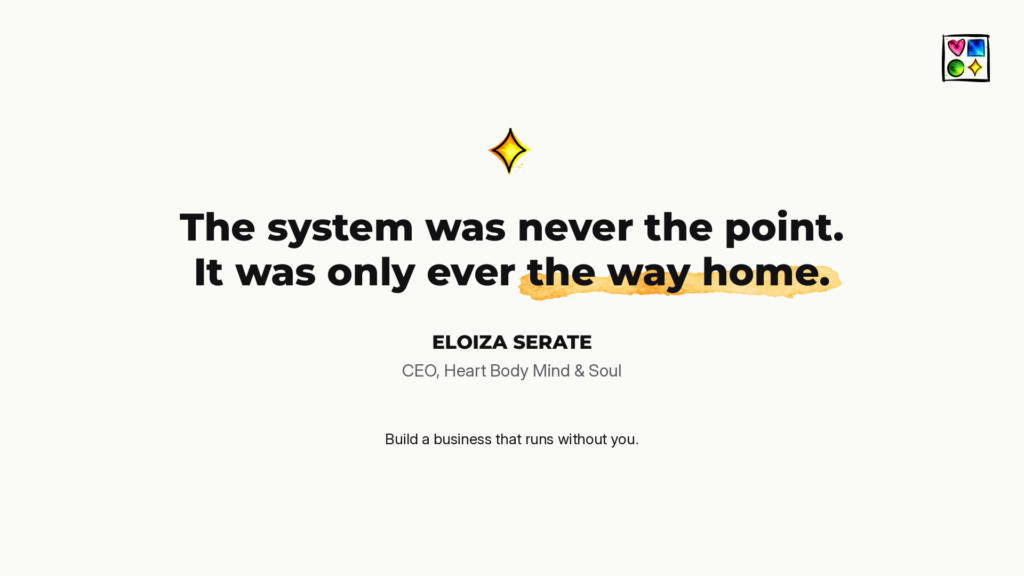
Heart. Body. Mind. Soul. Build in order. That is the map. Everything I build from here hangs on it.
Follow the Framework
If HBMS gives language to something you have been living in your own agency, subscribe to The Way Home, my newsletter under HBMS.
Over the coming weeks, I will go deeper into each layer: why you are the bottleneck, the week my agency fell apart, why roles matter more than heroes, and how to map your business as it really is instead of how you wish it were.
Subscribe to The Way Home, and join the waitlist if you are ready to build an agency that does not depend on you to hold everything together.
Frequently Asked Questions
What is the HBMS framework?
HBMS stands for Heart, Body, Mind, and Soul. It is an operating system for agency owners, built in a set order: Heart (the company’s purpose, why it exists), Body (the system itself: People, Process, Platform, and Performance), Mind (AI and judgment layered onto a system that already works), and Soul (the owner, the layer that is not in the software). Three layers you build, and one that holds you up.
What is an agency operating system?
An agency operating system is the structure that lets a service business deliver consistent results without routing every decision through the founder. In the HBMS framework, this is Body, the system itself: People (who owns what), Process (how work moves), and Platform (where work is visible and trackable), with Performance at the center as the measurable result.
How do I stop being the bottleneck in my agency?
The founder bottleneck is usually a Body problem, meaning the system itself is missing. People do not have clear ownership. Process is not documented. Platform is not making work visible. Start by mapping where decisions currently route through you, then install ownership, documented processes, and a single system of record so your team can operate without waiting for you.
What is the difference between automation and AI in business operations?
Automation is rules-based execution: when this happens, do that. AI supports judgment: it helps interpret information, surface patterns, and assist with decisions. In the HBMS framework, automation belongs in Body, the operating system, while AI belongs in Mind, the judgment layer. Automation executes defined workflows. AI supports judgment by helping people interpret information, surface patterns, and make better decisions. Neither can fix a broken system. Automation needs a defined workflow, and AI needs consistently recorded information.
How do I build systems that let my agency run without me?
Start with Heart, the company’s purpose, so your team has a filter for decisions. Then build Body, the system itself: define who owns what, document how work moves, and make it visible in one platform. Layer in Mind, AI and judgment on top of that working system, for speed and insight. Then tend to Soul, the owner behind the system, and the personal patterns that keep you holding on. The order matters because each layer depends on the one before it.
Want to hear the latest news about Virtual Champions PH?
This could be the start of something awesome! Subscribe to our newsletter. Stay updated with exclusive tips, articles, new product tools and notifications, as well as special service offers from VCPH conveniently in your inbox!
