
From Tribal Knowledge to Repeatable Systems: How to Build Processes Your Team Can Actually Follow
By Eloiza Mariano Serate
Picture this: your operations coordinator is on leave, and a long-standing client asks why this month’s report hasn’t arrived. Nobody else knows which data goes into it, where the template lives, or who approves it. The report goes out three days late, and it still looks different from last month’s.
Or think of a new hire who asks the same questions for a month because the answers are scattered across chat threads and other people’s memories.
Neither is really a people problem. Both are symptoms of a business running on tribal knowledge: work that gets done because certain people remember how, not because the business has a clear, shared way of doing it.
This is where business process documentation earns its place, not as a binder of manuals nobody opens, but as a way to make important work clear, repeatable, measurable, and transferable. Our earlier article on the hidden cost of broken processes covered the warning signs. This one covers what comes next: turning what your people know into workflows your whole team can run.
What Tribal Knowledge Looks Like in a Growing Business
Tribal knowledge is the know-how that lives in people’s heads instead of in a shared, accessible system. It includes the steps, shortcuts, client preferences, and judgment calls that nobody has written down.
In everyday operations, it tends to look like this:
Only one person knows how a critical process works
Instructions are buried in chat threads and email chains
The same task is done three different ways by three team members
New hires learn by shadowing and asking the same questions
Routine decisions wait for the founder or a manager
Work stalls whenever a key person is unavailable
In a team of five, this feels manageable because the person who knows is one message away. But every new hire, client, and service line adds another layer of knowledge that has to travel from person to person. Eventually, the business is no longer limited by demand or talent. It is limited by how fast knowledge can move.
The scale of the problem is easy to underestimate. In its Workplace Knowledge and Productivity Report, based on a YouGov survey of 1,001 U.S. workers, Panopto found that 42% of institutional knowledge is unique to the individual employee. Workers also reported spending an average of 5.3 hours a week either waiting for vital information from colleagues or recreating knowledge that already exists. That study focused on organizations with at least 200 employees, but the risk is just as easy to recognize in a smaller team, where a single absence can stall an entire function.
Why Undocumented Processes Create Operational Risk
Undocumented processes rarely fail loudly. They fail through small, repeated costs.
Quality starts to depend on who handles the work. Mistakes repeat because there is no standard to check against. Approvals stall because nobody is sure who can decide. Onboarding drags, and it is a widespread weakness: Gallup has found that only 12% of employees strongly agree their organization does a great job of onboarding new employees. When someone resigns, their knowledge leaves with them. Accountability weakens because nobody can be held to a standard that was never defined, and each of these gaps becomes a bottleneck the moment the business tries to grow.
Consider a growing agency where one account manager handles billing for every retainer client. She knows the billing dates, which clients need purchase order numbers, and which have negotiated rates. None of it is written down. When she takes two weeks off, invoices go out late, two clients are billed at the wrong rate, and the founder spends several evenings fixing it.
Technically, nothing “broke.” The business looked healthy right up until one absence revealed that a single person’s memory was its billing system. That is the hidden cost of undocumented work.
Which Business Processes Should You Document First?
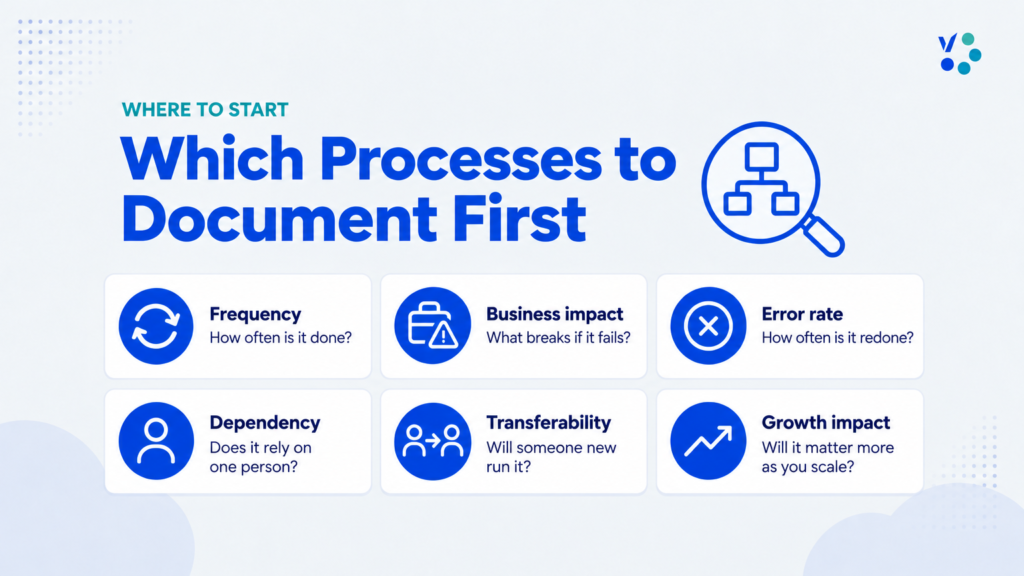
Documenting everything at once is the fastest way to stall. Score your processes against six questions instead:
Frequency: How often is the process performed?
Business impact: What happens to clients, revenue, or compliance if it fails?
Error rate: How often does it go wrong or require rework?
Dependency: Does it rely on a single person?
Transferability: Will someone else need to perform it soon, such as a new hire or virtual assistant?
Growth impact: Will it matter more as the business expands?
The Anatomy of a Useful Standard Operating Procedure (SOP)
A useful SOP answers the questions a capable person would ask the first time. It includes nine elements:
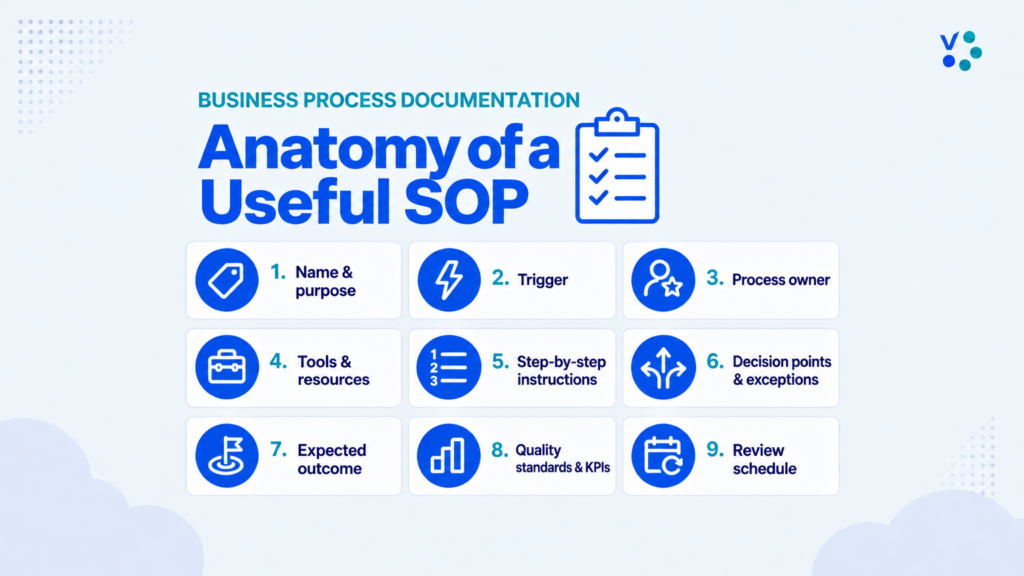
Process name and purpose: what the process accomplishes and why it matters
Trigger: the event or condition that starts it
Process owner: the person accountable for it
Tools and resources: the systems, templates, and information needed
Step-by-step instructions: clear actions in the correct order
Decision points and exceptions: what to do when something unexpected happens
Expected outcome: what “done” looks like
Quality standards and KPIs: how accuracy and timeliness are measured
Review information: who maintains the SOP and when it is reviewed
Example: A Short New Client Onboarding SOP
Purpose: Give every new client a consistent, professional start within five business days of signing.
Trigger: Signed agreement and first payment received.
Owner: Client Success Lead.
Tools: CRM, onboarding form, welcome email and workspace templates.
Steps: (1) Send the welcome email and onboarding form within one business day. (2) Create the client workspace from the template. (3) Schedule the kickoff within three business days. (4) Assign the delivery team and confirm the start date.
Exceptions: If the form isn’t returned within two business days, send one reminder, then escalate to the account owner.
Outcome: Kickoff completed and delivery team assigned.
KPIs: Kickoff held within five business days; onboarding form completion rate.
Review: Quarterly, by the Client Success Lead.
It fits on one page, and that is the point. Even ISO 9001, the international standard for quality management, asks organizations to maintain documented information “to the extent necessary to support the operation of processes,” not to document everything. The best SOP is not the longest. It is the one your team can understand, follow, and apply consistently.
Turning an SOP Into a Repeatable Workflow
Turning an SOP Into a Repeatable Workflow
Documenting a process and operationalizing it are different things. An SOP describes how work should happen. A workflow makes it happen the same way every time.
The bridge between the two is structure: clearly defined tasks, assigned responsibilities, consistent triggers, standardized templates, checklists, defined handoffs, quality checkpoints, and completion tracking.
Before: Client inquiries arrive through the website, email, and social media. Whoever sees one first replies, if they remember. Some get a reply within an hour, others wait three days, and a few are never answered at all.
After: Every inquiry, from every channel, lands in one shared queue. Each is assigned to a named owner, who responds using a standard template within one business day. Qualified leads are handed to sales with a completed intake checklist, and a weekly review flags anything still open.
The procedure itself barely changed. The difference is that it now runs inside the team’s daily tools instead of sitting in a document. Documentation only creates value when it shapes how work actually gets done.
Assigning Ownership and Accountability
Even a well-written SOP fails without clear ownership. Three roles matter:
The doer completes the task.
The process owner is accountable for how the process performs over time, including errors, delays, and updates.
The leader reviews outcomes and removes obstacles.
When these roles blur, deadlines slip, work is duplicated, and small issues escalate to the founder.
A few practical tools help: a responsibility matrix such as RACI (Responsible, Accountable, Consulted, Informed), one named owner per task, a regular review rhythm, and a small set of KPIs tied to each expected outcome.
Done well, accountability reduces micromanagement. When owners and standards are visible, leaders can review outcomes and step in only when results call for it.
When Should Automation Enter the Process?
Technology should support a process, not complicate it. A new tool can make a clear process faster, but it cannot make an unclear one clear. Automation works the same way: it magnifies whatever it touches. Automate a confusing workflow, and you get confusion at speed.
Stabilize the process first. Once it runs consistently by hand, the right opportunities become obvious: lead assignment, appointment reminders, task creation, follow-up notifications, status updates, document routing, and routine reporting.
Keep people involved in exceptions and judgment calls. The goal is to remove repetitive work, not responsibility.
The rule is simple: automate a process because it works, not because it is broken.
How to Keep Business Process Documentation Updated and Relevant
A process documented in January can be outdated by June. To keep your SOPs current:
Give every SOP a named owner
Set a review schedule, at least quarterly for critical processes
Invite feedback from the people who do the work
Watch for recurring errors and bottlenecks
Update workflows after any operational change
Maintain version control so everyone uses the current version
Store everything in one central, searchable location
Treat documentation as a living resource, not an archive. Once people stop trusting it, they go back to asking each other.
From Documentation to Operational Independence
When knowledge moves into shared workflows, service becomes consistent, onboarding speeds up, and teams coordinate without endless status meetings. Accountability is clear, leaders gain visibility without chasing updates, and the founder stops being the default answer to every question.
That is operational independence: a business that runs well even when any one person, including the founder, is unavailable. (For a deeper look at removing the founder bottleneck, see how to build an agency that runs without you.)
At Virtual Champions PH, this is the work we do alongside our clients: capturing how work really gets done, designing practical SOPs and workflows, establishing clear ownership, and supporting execution through skilled virtual professionals and the right automation. The goal is not more documentation. It is a business your team can run with confidence.
Conclusion: Build More Repeatable Operations
Sustainable operations should never depend on what one person remembers. Documentation turns individual knowledge into organizational capability, and that is what creates clarity, consistency, accountability, and continuity.
As you close out the year, look past next year’s targets and ask a harder question: which of your processes still live in someone’s head? Resetting them now means walking into 2027 on a stronger operational foundation, with workflows your team can run with or without you in the room.
Build More Repeatable Operations.
Your business shouldn’t have to depend on one person’s memory to keep moving. Discover how Virtual Champions PH can help you strengthen your workflows, improve operational clarity, and build more consistent business processes.
Sources
Panopto, Workplace Knowledge and Productivity Report (2018), online survey of 1,001 U.S. workers conducted with YouGov: https://www.prnewswire.com/news-releases/inefficient-knowledge-sharing-costs-large-businesses-47-million-per-year-300681971.html
Gallup, “Why the Onboarding Experience Is Key for Retention”: https://www.gallup.com/workplace/235121/why-onboarding-experience-key-retention.aspx
ISO, Guidance on the Requirements for Documented Information of ISO 9001:2015 (quoting clause 4.4): https://www.iso.org/iso/documented_information.pdf
Note: Panopto’s survey covered U.S. adults employed at organizations with 200+ employees and with at least five years of total work experience.
Want to hear the latest news about Virtual Champions PH?
This could be the start of something awesome! Subscribe to our newsletter. Stay updated with exclusive tips, articles, new product tools and notifications, as well as special service offers from VCPH conveniently in your inbox!
