

E-commerce Operations:
The Systems You Need to Scale
By Eloiza Mariano Serate

For an e-commerce business, growth can look deceptively simple.
More website visitors. More orders. More customers. Higher revenue.
But behind every successful order is a network of operational activities. Inventory needs to be tracked, orders need to be processed, customers need timely responses, vendors need coordination, reports need to be reviewed, and follow-ups need to happen consistently.
When sales grow faster than the systems supporting them, the business can quickly become overwhelmed.
Customer inquiries get missed. Inventory information becomes unreliable. Order issues take longer to resolve. Administrative work takes over the founder’s day. Team members develop different ways of completing the same tasks, creating inconsistency across the business.
The storefront may be where customers see your business, but your backend operations determine how well that business can scale.
For growing e-commerce businesses, building strong operational systems isn’t about adding unnecessary complexity. It’s about creating clear processes, workflows, automation, and support structures that allow the business to handle more volume without creating the same increase in manual work.
Why E-commerce Growth Creates Operational Pressure
In the early stages, it’s normal for a founder to wear a lot of hats.
They might check orders in the morning, answer customer messages during the day, contact a supplier in the afternoon, and update a spreadsheet before going to bed.
When there are only a few orders coming in, this can be manageable.
The challenge is that the same approach doesn’t always work once the business starts gaining momentum.
A process that works for 20 orders a week may not work for 200. The founder who used to answer every customer message may no longer have the time to do so. A spreadsheet that once gave the team enough visibility may become difficult to maintain.
The work hasn’t necessarily become harder. There’s simply more of it.
And when more work is added without improving the underlying processes, the pressure starts showing up in different parts of the business.
Teams spend more time on repetitive tasks. Customers wait longer for responses. Information becomes harder to find. Important tasks depend on one or two people remembering to do them.
This is one of the most common challenges of e-commerce growth:
Sales can increase faster than the systems supporting the business.
That’s why operational planning needs to be part of the growth conversation, not something that gets addressed only after the business starts struggling.
What Happens When the Backend Doesn't Scale?
When an e-commerce operation grows without updating its processes, the problems are often gradual.
Nothing necessarily breaks overnight. Instead, small inefficiencies start adding up.
1. Too Much Depends on One Person
Maybe only one person knows how to handle complicated returns. Maybe the founder is the only person who knows which supplier to contact. Maybe a particular report can only be prepared by one team member.
At first, this might not seem like a problem.
But if that person is unavailable, the work can come to a stop.
Documenting processes and sharing responsibilities helps move important knowledge out of individual people’s heads and into the business itself.
2. Repetitive Work Takes Over
Copying information between platforms. Sending the same follow-up messages. Updating spreadsheets. Creating recurring tasks. Pulling information for reports.
None of these tasks seem particularly difficult. The problem is how often they happen.
When the same manual tasks are repeated every day or every week, they can take up time that your team could be spending on customers, strategy, and work that actually requires human input.
3. Customers Get Different Experiences
As the number of customers increases, consistency becomes more important.
Without clear customer support processes, one customer might receive a response within minutes while another waits until the next day. Different team members may also give different answers to the same question.
Templates, guidelines, and escalation procedures give the team a starting point without turning every customer interaction into a rigid script.
4. Small Errors Become Bigger Problems
An outdated inventory number might lead to an order that can’t be fulfilled.
A missed handoff might delay a shipment.
A forgotten follow-up might result in a frustrated customer.
The bigger an operation becomes, the harder it is to rely on memory and informal communication alone.
5. The Founder Becomes the Backup for Everything
This is perhaps the easiest problem to recognize.
The business is growing, but the founder still gets pulled into questions like:
“Where can I find this?”
“Did anyone follow up with that customer?”
“Has this order been processed?”
“Who is handling this?”
When leadership becomes the safety net for every small operational issue, there is less time available for strategy and growth.
The answer isn’t always to work longer hours. Often, it’s to look at how the work is being done in the first place.
6 Operational Areas E-commerce Businesses Should Systemize
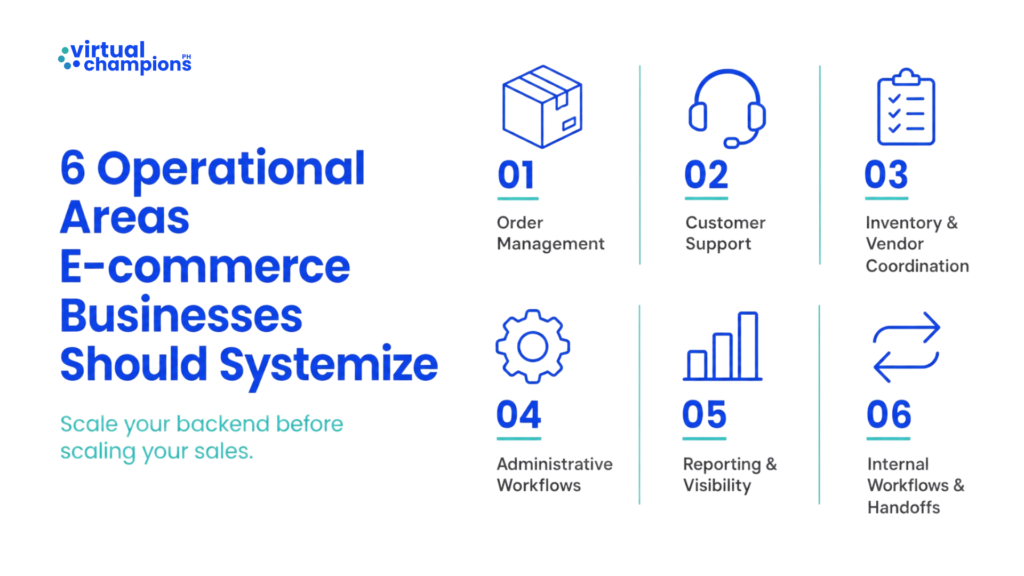
There isn’t one perfect setup for every e-commerce business. The systems you need will depend on your products, order volume, team, sales channels, and current challenges.
Still, there are several areas worth reviewing as your business grows.
1. Order Management
The order process should be clear from the moment a customer places an order through fulfillment and delivery.
Depending on your business, that may include:
Order verification
Payment confirmation
Fulfillment coordination
Shipping updates
Failed deliveries or other exceptions
Returns and refunds
Customer notifications
The important part is knowing what happens at each stage and who owns it. A documented order workflow means the team doesn’t have to rely on someone remembering the next step every time an order comes in.
2. Customer Support
More customers usually means more questions.
Some are simple: “Where is my order?”
Others require more work: “My package arrived damaged. What should I do?”
It’s helpful to have a process for common situations, including:
Product questions
Order status requests
Shipping delays
Returns
Refunds
Complaints
Exchanges
Frequently asked questions
This doesn’t mean every response needs to sound exactly the same.
Instead, give your team the information they need to respond confidently, along with clear guidelines for situations that need to be escalated.
3. Inventory and Vendor Coordination
Inventory issues can quickly turn into customer issues.
If a product is unavailable but still showing as in stock, you may end up dealing with cancellations or unhappy customers. If supplier follow-ups aren’t tracked, restocking can also become reactive.
Your process should give the team visibility into things such as:
Current stock levels
Low-stock items
Purchase orders
Supplier communication
Restocking schedules
Product availability
Vendor follow-ups
You don’t necessarily need a complicated inventory setup.
You need a reliable way for the right people to see what’s happening and know what needs attention.
4. Administrative Workflows
Administrative work tends to grow quietly alongside the business.
There are spreadsheets to update, documents to organize, invoices to process, meetings to coordinate, reports to prepare, and customer information to maintain.
Some of these tasks only take a few minutes. But a few minutes repeated across dozens of tasks can become hours every week.
Creating simple, repeatable workflows makes administrative work easier to hand off and identify opportunities for automation.
5. Reporting and Operational Visibility
It’s difficult to make good decisions when you don’t have a clear picture of what’s happening.
Your reporting may include information such as:
Orders
Revenue
Average order value
Customer support volume
Returns
Fulfillment issues
Inventory levels
Marketing performance
Operational costs
The goal isn’t to produce a report just because it’s Friday and someone needs to fill one out.
The goal is to answer useful questions.
Where are orders getting delayed?
Which customer issues keep coming up?
Are inventory problems becoming more frequent?
Where is the team spending most of its time?
Good reporting helps turn day-to-day activity into information you can actually use.
6. Internal Workflows and Handoffs
As your team grows, more work moves from one person to another.
Customer support might need help from operations. Operations might need information from inventory. Inventory might need to contact a supplier.
Without a clear handoff, it’s easy for a task to sit between two people while everyone assumes someone else is handling it.
A useful workflow should answer four basic questions:
Who owns it?
What happens next?
When does it need to happen?
Where is the information recorded?
That level of clarity becomes much more important as the business gets bigger.
Where Automation Can Remove Repetitive Work
Automation can save a team a lot of time, but not every task needs to be automated.
Start by looking at the work your team repeats over and over.
If a task follows the same steps, has predictable inputs and outputs, and doesn’t require much judgment, it’s a good candidate to review for automation.
For example, you might automate:
Order notifications
Customer follow-up emails
Low-stock alerts
Task creation
Internal notifications
Appointment scheduling
Data synchronization
Report generation
Customer segmentation
Routine reminders
The important thing is to fix the process before automating it.
If a workflow is confusing when people do it manually, automation won’t necessarily make it better.
Automation works best when it supports a process that already makes sense.
When to Delegate vs. Automate vs. Hire
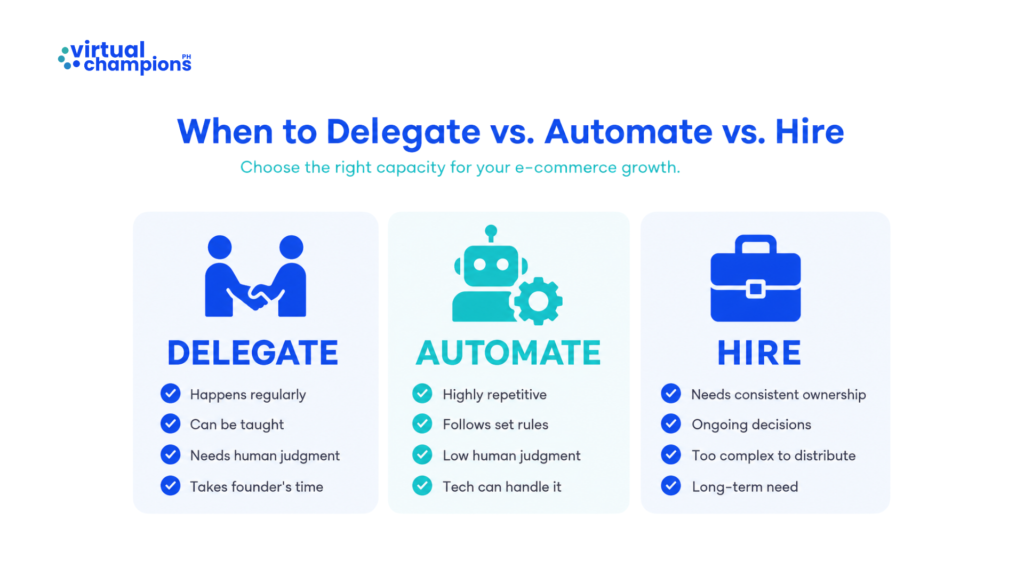
When the workload starts increasing, one of the first questions founders ask is:
“Do we need to hire someone?”
Sometimes the answer is yes. But there are other options worth considering first.
Delegate When:
Delegation can make sense when a task:
Happens regularly
Can be taught to someone else
Requires communication or human judgment
Is taking too much of the founder’s time
Administrative support, customer service, research, data management, and routine coordination are examples of work that may be delegated.
Automate When:
Automation is worth considering when a task:
Is highly repetitive
Follows predictable rules
Doesn’t require much human judgment
Can be handled reliably by your existing technology
Notifications, reminders, data transfers, and recurring task creation are common examples.
Hire When:
A dedicated hire may make more sense when:
The workload requires consistent ownership
The role involves ongoing decision-making
The function has become too complex to distribute
The business has a long-term need for that capacity
You may also end up using a combination of all three.
For example, an e-commerce business could automate order notifications, delegate customer support and administrative work, and keep strategic supplier relationships with its internal leadership team.
The point isn’t to find the one “correct” answer.
It’s to understand what kind of capacity the business actually needs.
How Operational Visibility Improves Decision-Making
Good systems don’t just make work easier. They also give business owners a clearer view of what’s happening inside the operation.
When information is captured consistently, patterns become easier to spot.
You may discover that:
Certain orders are regularly delayed
The same customer questions keep appearing
A particular product generates more support requests
Inventory problems come from the same point in the supply process
A specific administrative task takes far longer than expected
Team members are waiting on information before they can complete their work
A repetitive process could be automated
Instead of saying:
“Why does everything feel so busy?”
you can start asking:
“Where is the bottleneck?”
That shift matters. It gives you something specific to investigate and improve instead of trying to solve everything at once.
Building an E-commerce Operation Designed for the Next Stage of Growth
You don’t have to wait until your business is overwhelmed before improving its systems.
In fact, it’s much easier to make changes when you can still see where things are going wrong.
A growing e-commerce operation should aim for a few basic things.
Clear Processes
Your team should know how recurring tasks are supposed to be handled.
Defined Ownership
Every important task should have someone responsible for moving it forward.
Easy-to-Find Information
People shouldn’t have to search through multiple chats, spreadsheets, and inboxes just to find the information they need.
Repeatable Workflows
The business should be able to complete important tasks consistently, even when a particular team member is unavailable.
Useful Automation
Technology should take care of repetitive work where it makes sense, rather than being added simply because a tool has an automation feature.
The Right Support
Founders shouldn’t have to personally oversee every administrative detail just because they started the business.
Regular Improvement
Your processes should change when the business changes. A workflow that made sense when you had three people on the team may need to be redesigned when you have fifteen.
That’s part of scaling.
Growing an e-commerce business isn’t just about generating more sales. It’s about making sure the operation can support those sales.
Growth Needs a Backend That Can Keep Up
Your website might be where the customer experience begins, but the work behind the scenes determines what happens after someone clicks “Place Order.”
As your business grows, it’s worth asking two questions:
“How can we generate more orders?”
and
“Can our current operation handle them?”
If the answer to the second question is uncertain, that’s a sign to look at your processes before the next stage of growth puts even more pressure on them.
You may not need more software. You may not need a larger team.
You may simply need clearer workflows, better documentation, more visibility, or additional operational support.
At Virtual Champions PH, we help businesses strengthen the operational side of growth through e-commerce support, administrative assistance, workflow management, process documentation, customer support, and specialized business support.
The goal is simple: help your team spend less time chasing tasks and more time moving the business forward.
Your next stage of growth shouldn’t depend on everyone simply working harder. It should be supported by systems that make the work easier to manage.
Ready to Strengthen Your E-commerce Operations?
If your e-commerce business is growing and your current processes are starting to feel stretched, let’s take a closer look at what’s happening behind the storefront.
Book a Strategy Call or Explore E-commerce Support with Virtual Champions PH.
Want to hear the latest news about Virtual Champions PH?
This could be the start of something awesome! Subscribe to our newsletter. Stay updated with exclusive tips, articles, new product tools and notifications, as well as special service offers from VCPH conveniently in your inbox!
