

Our Clients Used to Struggle With These 3 Workflow Problems Before Q3. Here's the Fix.
By Eloiza Mariano Serate

Q3 has a way of revealing what your business has been quietly tolerating.
Before the busy season begins, the small gaps can feel manageable. A delayed approval here. A campaign task missed there. A client deliverable that needed three follow-ups before it moved. Nothing looks like a major breakdown yet, so everyone keeps going.
But once the volume increases, those small workflow problems start to show their real cost.
At Virtual Champions PH, we have seen this happen with founders, agencies, operations teams, and growing businesses that already have capable people in place. The issue is usually not that the team is lazy. It is not always that they lack skill. Most of the time, the real problem is that the business has outgrown the way work is being managed.
The tools are there. The people are working. The goals are written.
But the system is not carrying the business the way it should.
And this is exactly why a midyear operations review matters. Q3 is not the best time to discover that your workflow architecture is weak. The better move is to catch the cracks before the second half of the year gets heavier.
Here are the three workflow problems we often see before Q3, and how we help businesses fix them.

1. The Work Is Living in Too Many Places
One of the first things we look for when a client comes to us is this:
Where does the work actually live?
For many teams, the answer is not clear.
The updates are in Slack. The approvals are in email. The files are in Google Drive. The task is in ClickUp, but the latest instruction is buried in a chat thread. Someone has a spreadsheet that used to be the source of truth, but now nobody knows if it is still updated.
Everyone is technically working, but the work is scattered.
This creates a hidden problem. Your team spends too much time looking for context instead of moving the work forward. They are not just doing the task. They are also chasing information, confirming ownership, checking old messages, and asking, “Ito ba yung latest? (Is this the lates update?)”
That kind of friction might feel small in Q2. But when Q3 arrives and the workload increases, scattered work becomes a speed problem.
The question your team needs to answer quickly is simple:
What is moving right now, who owns it, and what is blocking it?
If your system cannot answer that in one place, your team will keep depending on memory, follow-ups, and manual coordination. That is where deadlines start slipping, even when everyone is trying their best.
How VCPH Helps Fix This
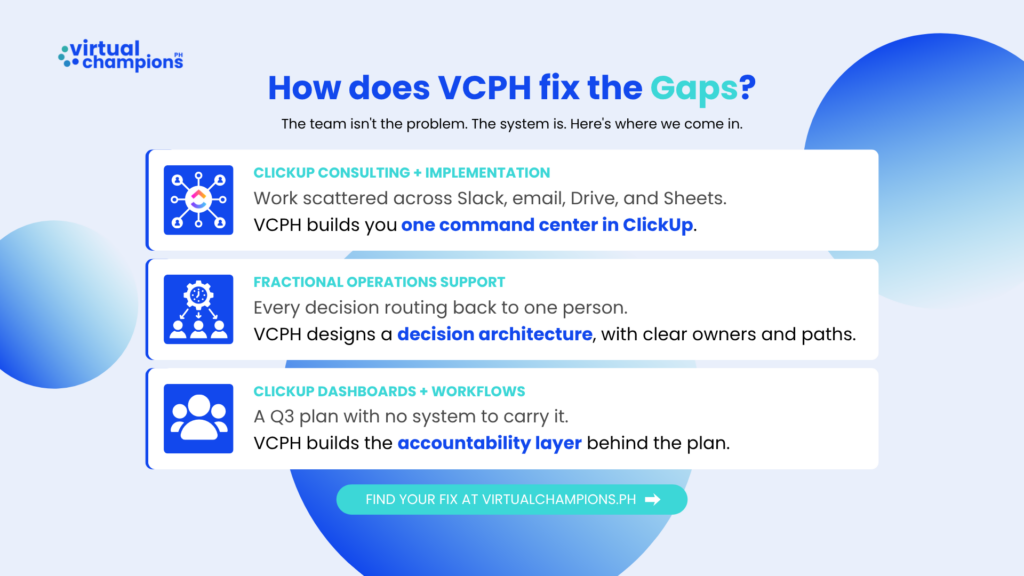
When we come in through ClickUp Consulting, ClickUp Implementation, or Fractional Support, we do not start by making the workspace look pretty.
We start by understanding how the business actually works.
We look at the active workstreams, where decisions are being made, where files are stored, how tasks are assigned, how deadlines are tracked, and how the team communicates. From there, we design a clearer center of gravity for the business.
For some clients, that means rebuilding their ClickUp workspace so it reflects their current operations, not how their business looked one year ago. For others, it means cleaning up duplicated workflows, creating task ownership rules, building dashboards, and making sure the team knows where to go for the latest update.
Because a good system should reduce confusion.
Your team should not need five tools and three follow-ups just to know what to do next.

2. Decisions Are Still Running Through One Person
This is one of the most common operational bottlenecks we see, especially in founder-led businesses.
There is one person who approves everything.
One person who knows the full context.
One person everyone waits for before moving forward.
Sometimes that person is the founder. Sometimes it is the operations lead. Sometimes it is the most experienced team member who has been carrying the business informally for years.
At first, this can look like strong leadership. The founder is involved. The ops lead is hands-on. The team feels supported.
But over time, the business becomes too dependent on one person’s availability.
Every approval lands in the same inbox. Every exception gets escalated to the same person. Every “just checking” message is really asking, “Can you decide so we can move?”
The team is not slow. The decision system is slow.
And during Q3, this becomes risky because the workload is heavier, the deadlines are tighter, and one person can only absorb so much.
The real warning sign is not that your team asks questions. Good teams ask good questions.
The warning sign is when your team cannot move unless one specific person answers.
That means the business does not have a clear decision architecture. It does not have enough ownership clarity. It does not have an escalation path that allows work to move without everything going back to the top.
How VCPH Helps Fix This
This is where Fractional Operations Support becomes valuable.
When VCPH steps in, we help define how decisions should move inside the business. We clarify who owns what, which decisions can be made independently, which ones need approval, and what should happen when something breaks.
We help remove the founder or senior lead from being the “traffic light” of the entire operation.
This does not mean removing leadership from the process. It means designing a healthier system where leadership is not forced to approve every small movement just to keep the business running.
For example, if a client deliverable is delayed, the team should already know who is responsible for updating the client, who adjusts the timeline, who reviews the risk, and when the issue should be escalated.
That should not require ten messages and a weekend rescue from the founder.
Fractional Support is not just extra hands. It is senior operational thinking embedded into the business so the team can move with more clarity, confidence, and accountability.

3. Your Q3 Plan Exists, But Your Q3 System Does Not
Many businesses enter Q3 with a plan.
The goals are written. The revenue targets are set. The campaigns are listed. The team had the planning meeting. Everyone nodded. Everyone understood the direction.
But a plan and a system are not the same thing.
A plan tells the business where it wants to go.
A system carries the business there.
This is where many teams struggle. They know the goals, but they do not have the operational infrastructure behind those goals.
Who owns each priority?
How will progress be tracked?
What happens if two deadlines conflict?
Where do blockers get reported?
How will leadership know if the business is on track or quietly falling behind?
What happens if a key team member is unavailable during peak season?
If these questions are not answered before Q3, the team will answer them while already under pressure. That is when even good plans start to break down.
A plan without a system becomes a calendar with ambition.
It looks organized on paper, but the execution still depends on constant reminders, manual follow-ups, and people remembering what was said during the last meeting.
And to be honest, that is not sustainable.
Not for the founder. Not for the team. Not for the clients who are expecting the business to deliver consistently.
How VCPH Helps Fix This
When we help clients prepare for Q3, we look at the gap between strategy and execution.
We do not just ask, “What is the goal?”
We ask:
How will this goal move every week?
Who owns each part?
Where will progress be visible?
What happens when something is delayed?
How will the team know what matters most?
From there, we help build the accountability layer behind the plan. This can include ClickUp dashboards, workflow structures, project templates, recurring check-ins, escalation paths, and clearer ownership mapping.
For clients that already use ClickUp, this often means turning ClickUp from a task storage space into a real operational command center.
Because having ClickUp is not the same as having a working ClickUp system.
A strong ClickUp implementation should help the team see priorities, track movement, spot blockers, and understand what needs attention before the problem becomes expensive.
That is the difference between a Q3 you simply survive and a Q3 you can actually run.
The Real Problem Is Usually Not Effort
One thing we always want business owners to understand is this:
Broken workflows do not always look dramatic.
They often look like small delays. Repeated questions. Tasks that are technically done, but not quite right. Team members who are busy all day but cannot clearly show what moved. Founders who feel tired because everything still somehow comes back to them.
These are not always people problems.
Many times, they are system problems.
And when the system is unclear, even the best people will struggle to perform consistently.
That is why fixing broken workflows before Q3 is not about asking your team to work harder. It is about giving them a structure that allows their effort to produce better results.
Your team needs one clear place for work.
They need decision rules that do not depend on one person’s availability.
They need a system behind the plan, not just a plan written in a document.
When those pieces are in place, the business becomes easier to lead, easier to manage, and easier to scale.
Is It Too Late to Fix This Before Q3?
Not necessarily.
But the earlier you look at the gaps, the more you can still fix before the pressure gets heavier.
A focused midyear operations review can already show where work is scattered, where decisions are getting stuck, and where your Q3 plan needs stronger execution support.
From there, VCPH can help you identify what needs to be cleaned up, rebuilt, delegated, automated, or structured better inside your operations.
Some businesses need ClickUp Consulting.
Some need a full ClickUp Implementation.
Some need Fractional Operations Support.
Some need a combination of all three.
The right solution depends on where the bottleneck is actually coming from.
That is why we do not believe in giving generic advice when the problem is operational. Your business has its own structure, team rhythm, tools, and growth stage. The fix should match the reality of how your team works.
Ready to Fix This Before Q3 Gets Heavier?
If your work is scattered, your team is waiting on one person for decisions, or your Q3 plan exists without a real system behind it, this is the right time to pause and look at the cracks.
Not when the busy season is already overwhelming the team.
Now.
At Virtual Champions PH, we help businesses build clearer workflows, stronger ClickUp systems, and operational structures that support real execution.
We come in to help you see what is not working, map what needs to change, and build the system that can carry your next stage of growth.
If this blog felt familiar, we invite you to book a free discovery call with VCPH.
Let us look at your current workflow gaps together and identify what your business needs before Q3 gets heavier.
Because your team does not just need another plan.
Your team needs a system that can carry the plan.
Ready to fix the gaps before they become bigger problems?
Want to hear the latest news about Virtual Champions PH?
This could be the start of something awesome! Subscribe to our newsletter. Stay updated with exclusive tips, articles, new product tools and notifications, as well as special service offers from VCPH conveniently in your inbox!
