

When Does Fractional Support Make More Sense Than Hiring Full-Time?
By Eloiza Mariano Serate

It usually starts with a very familiar moment.
You know your business needs help. Not just another pair of hands, but real senior-level support. Someone who can step in, take ownership, make decisions, build systems, guide the team, and help move the business forward without you carrying every single thing yourself.
So you open a job description.
Then you open the salary range.
Then you start adding the benefits, onboarding time, management load, tools, taxes, and the risk of getting it wrong.
And suddenly, the decision that was supposed to make your business lighter starts to feel heavy.
We have seen this happen to many founders and business owners. They know they need support. They know the business cannot keep growing with everything sitting on their plate. But hiring full-time feels like too much, too soon.
That is exactly where fractional support starts to make sense.
Fractional support is not about cutting corners. It is not about hiring cheap help. And it is definitely not about lowering your standards.
It is about getting the right level of expertise at the right stage of your business.
Because sometimes, your business does not need a full-time executive yet. Sometimes, what it needs is a senior expert who can come in, take ownership of a function, fix what is slowing you down, build what is missing, and help you grow without adding unnecessary weight to your payroll.
That is the real value of fractional support.
So when does fractional support make more sense than hiring full-time? Let us walk through it.
What Fractional Support Actually Means
The word “fractional” gets used a lot now.
Fractional COO. Fractional CMO. Fractional CFO. Fractional operations lead. Fractional project manager.
But what does it actually mean?
Fractional support means bringing in an experienced professional to own a business function on a part-time, project-based, or ongoing limited-scope basis. They are not just there to complete tasks. They are not simply there to give advice. They are there to bring senior-level thinking, structure, execution, and accountability into the business.
That distinction matters.
A freelancer usually owns a deliverable.
A consultant usually gives recommendations.
A fractional expert owns a function.
A Fractional COO does not just tell you that your operations need improvement. They help build the workflows, clarify roles, improve team accountability, and make sure the business can run with less chaos.
A Fractional CMO does not just hand you a marketing plan. They help shape the strategy, guide the execution, track performance, and connect marketing activity to business growth.
A Fractional CFO does not just look at the books. They help you understand your numbers, prepare for risk, plan cash flow, and make smarter financial decisions before problems become expensive.
That is the difference.
Fractional support gives you access to expertise before you are ready for full-time headcount.
And for many growing businesses, that timing is everything.

The Real Cost of Hiring Full-Time
When business owners compare fractional support with full-time hiring, they often compare the wrong numbers.
They look at the monthly cost of a fractional engagement beside the base salary of a full-time employee and think, “Maybe full-time is more practical.”
But the salary is not the full cost.
A full-time hire comes with benefits, payroll taxes, equipment, software, paid leave, onboarding time, management time, and the hidden cost of waiting for that person to become fully productive.
According to the original draft, the U.S. Bureau of Labor Statistics places the true cost of a full-time employee at around 1.25x to 1.4x their base salary once benefits, taxes, insurance, and paid leave are included. That means an $80,000 salary can become $100,000 to $112,000 in actual cost before that person has fully delivered results.
And that is only the visible part.
There is also the ramp-up period.
Most senior hires need time to understand the business, the people, the systems, the clients, the history, and the priorities. Even the right person will not operate at full capacity on day one.
There is also the risk of hiring the wrong person.
A wrong senior hire does not just cost money. It costs momentum. It affects team morale. It creates confusion. It delays decisions. It often takes months before a founder admits, “This is not working.”
And then there is the emotional weight of a full-time commitment.
A full-time hire is not just a role. It is a promise.
When revenue shifts, when priorities change, or when the business realizes that the role it hired for is no longer the role it needs, that promise can become difficult and expensive to adjust.
Fractional support gives you more flexibility.
You can bring in expertise for the season you are in. You can solve the problem in front of you. You can build the foundation first. And when the need changes, the engagement can change with it.
For growing businesses, that flexibility is not a small benefit. It can be the difference between scaling wisely and carrying more overhead than the business is ready for.
When Fractional Support Is the Smarter Choice
There is a stage in business where the founder is doing too much, the team is stretched, and the business has clearly outgrown the way things used to work.
But it has not yet reached the point where every leadership function needs a full-time executive.
This is the fractional stage.
It is the stage where you need a CFO brain, but not a full-time CFO.
You need stronger operations, but not a full-time COO.
You need a clearer marketing strategy, but not a full internal marketing department.
You need someone senior enough to lead, but flexible enough to fit the current size and season of the business.
We see this often with founders who are growing fast, winning clients, and creating more opportunities, but their internal structure is starting to fall behind.
The business looks successful from the outside, but inside, the founder is still approving too many things, answering too many questions, fixing too many issues, and holding too much information in their head.
That is usually the signal.
Fractional support makes sense when:
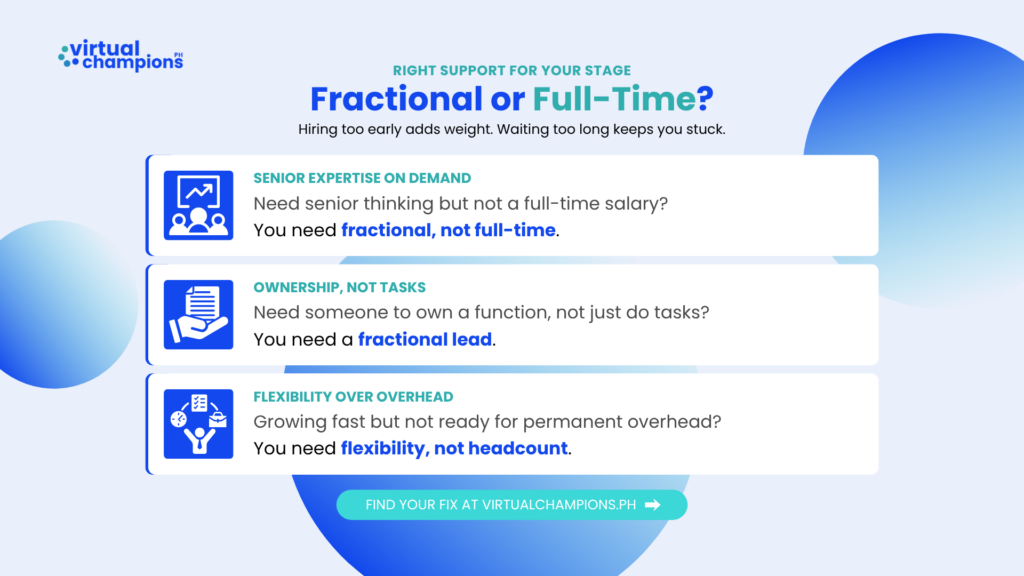
You need senior-level thinking, but your revenue does not yet support a senior-level full-time salary.
The function is important, but not yet big enough to fill a full-time role.
You need progress now, not after a long recruitment and onboarding process.
You want someone accountable to outcomes, not just someone completing tasks.
You are in a growth stage where flexibility matters more than permanence.
You need structure, leadership, and execution, but you do not want to add unnecessary overhead too early.
If more than one of these feels familiar, fractional support is worth considering.
Not because full-time hiring is wrong, but because timing matters.
Hiring too early can make the business heavier. Waiting too long can keep the founder stuck.
Fractional support gives you a practical middle path.
When Full-Time Hiring Makes More Sense
Fractional support is powerful, but it is not always the final answer.
There are moments when full-time hiring is the better choice.
If a function has grown large enough to require daily leadership, full-time may make more sense.
If the role requires deep institutional knowledge that needs to build over years, full-time may be the better investment.
If the person needs to be fully embedded in the culture, decision-making, and day-to-day leadership of the business, full-time may be right.
If your revenue is stable enough to carry the full cost of employment without strain, then bringing someone in permanently can be a strong next step.
The goal is not to choose fractional forever.
The goal is to choose the support model that matches the stage of the business.
Sometimes, fractional support becomes the bridge to a future full-time hire. It helps clarify what the role should actually be, what systems need to exist, what outcomes matter, and what kind of person the business will eventually need.
This is why we often tell business owners: do not hire full-time just because you are overwhelmed.
First, understand what kind of support your business actually needs.
Is it leadership?
Is it execution?
Is it strategy?
Is it systems?
Is it team management?
Is it financial visibility?
Is it operational clean-up?
Once that is clear, the hiring decision becomes much easier.

Why Filipino Excellence Belongs at the Center of the Fractional Conversation
This is the part of the conversation we believe more businesses need to hear.
When people talk about offshore or remote talent, they often start with cost.
But when we talk about Filipino professionals, cost should not be the main story.
Excellence should be.
Filipino professionals have been serving global businesses for decades across operations, finance, marketing, customer experience, project management, executive support, technology, and business administration.
Many have worked inside multinational companies, global remote teams, fast-paced startups, agencies, and service-based businesses. They understand international standards. They know how to collaborate across time zones. They are used to working with different cultures, different communication styles, and different levels of business maturity.
That experience matters.
Because fractional work requires more than skill.
It requires trust.
A fractional expert needs to enter a business, understand the situation quickly, build relationships fast, identify what is broken, and start creating movement without needing to be micromanaged every hour.
This is where Filipino professionals stand out.
There is a natural adaptability in the way Filipino professionals work. They know how to read the room. They know how to adjust their communication. They know how to be warm without losing professionalism. They bring care into the work without forgetting the outcomes.
That combination is rare.
The best Filipino professionals are not just task-takers. They are problem-solvers, team-builders, process thinkers, communicators, and trusted partners.
They take ownership.
They follow through.
They care about the quality of the work.
They understand that their role is not just to support the business, but to help make the business stronger.
At VCPH, this is something we deeply believe in because we have seen it again and again.
Filipino excellence is not a backup option.
It is not a cheaper alternative to “real” leadership.
It is world-class talent that many global businesses have not fully learned how to access yet.
That is part of why Virtual Champions PH exists.
We help bridge that gap.
We help growing businesses access Filipino professionals who can bring structure, strategy, accountability, and execution into the business. Not just as assistants. Not just as support staff. But as serious partners in growth.
And when fractional support is done well, Filipino professionals are exceptionally positioned to lead in this space.
They understand service, but they also understand ownership.
They understand collaboration, but they also understand independence.
They understand excellence, but they bring it with humility, warmth, and commitment.
That is the kind of support many growing businesses need right now.
How to Make a Fractional Engagement Work
Getting fractional support is one thing.
Getting the best results from it is another.
The most successful fractional engagements happen when both sides are clear from the beginning.
Your fractional partner brings the expertise, structure, and execution.
But the business owner also needs to bring access, context, and decision-making support.
Fractional support is not magic. It works best when the expert is set up to win.
Here is what that looks like.
Start With a Clear Brief
Before the engagement begins, define what function the fractional expert is stepping into.
Are they taking over operations?
Are they building the marketing system?
Are they improving financial visibility?
Are they managing projects?
Are they documenting SOPs?
Are they helping the team work better together?
The clearer the brief, the faster the results.
A fractional expert who knows what broken looks like and what success should feel like can move quickly.
A fractional expert who has to spend the first month guessing what the business needs will lose valuable time.
Build a Strong Check-In Rhythm
Fractional does not mean invisible.
The best engagements have regular check-ins, usually weekly or biweekly, where priorities are reviewed, blockers are discussed, and decisions are made.
This keeps the work accountable without turning the relationship into micromanagement.
It also gives the business owner visibility.
You should know what is moving, what is stuck, what decisions are needed, and what progress looks like.
Treat Them Like a Strategic Partner
Fractional support works best when the expert is treated as part of the leadership conversation.
Not just someone waiting for instructions.
Not just someone assigned to a task list.
But someone trusted to understand the business, raise concerns, recommend improvements, and help make better decisions.
This is where many founders get the most value.
A strong fractional partner does not only ask, “What do you want me to do?”
They also ask, “What should we fix first so the business can move better?”
That kind of thinking is what makes the model powerful.
The Real Question Is Not “Fractional or Full-Time?”
Many business owners think the decision is simple.
Should I hire full-time or not?
But the better question is:
What kind of support does my business need at this stage?
Because full-time hiring is not automatically better.
Fractional support is not automatically better either.
The right answer depends on your business stage, your revenue, your internal capacity, your growth plans, and the weight you are already carrying as the founder or leadership team.
If your business is still defining the function, fractional support can help you build it.
If your business needs senior thinking but not full-time hours, fractional support can give you that.
If your business is growing but not ready for permanent executive overhead, fractional support can create momentum without locking you into a long-term commitment too early.
And if the function eventually becomes big enough for a full-time hire, you will be making that decision from a stronger, clearer, more stable place.
That is the point.
Fractional support helps you grow without forcing your business to carry more than it is ready for.
Frequently Asked Questions
How much does fractional support cost compared to hiring full-time?
The cost depends on the function, scope, and level of support needed.
But in many cases, fractional support gives you access to senior-level expertise at a lower overall cost than hiring a full-time equivalent. That is because you are not carrying the full salary, benefits, taxes, onboarding time, and long-term employment commitment.
You are paying for focused expertise, defined outcomes, and the level of involvement your business actually needs right now.
For a growing business, that can be a much smarter use of resources.
How do I know if my business needs fractional support or a full-time hire?
Start with scope.
If the function is important but not yet large enough to require someone full-time every day, fractional support may be the better fit.
If your revenue cannot comfortably support the full cost of a senior hire, fractional support may also be the safer path.
But if the function has grown to the point where it requires daily leadership, deep internal involvement, and long-term ownership, then full-time may make more sense.
When in doubt, fractional support can be a practical starting point. It allows you to test the need, build the structure, and understand what the business truly requires before committing to a permanent hire.
What does a Fractional COO, CMO, or CFO actually do?
A Fractional COO helps improve how the business runs. This can include workflows, systems, team accountability, operations planning, SOPs, project management, and overall execution.
A Fractional CMO helps lead marketing strategy and execution. This can include campaign direction, messaging, performance tracking, content strategy, team coordination, and growth planning.
A Fractional CFO helps strengthen financial visibility and decision-making. This can include cash flow planning, budgeting, forecasting, risk visibility, and financial structure.
The key word is ownership.
A fractional expert does not just give advice. They help lead the function.
Can Filipino fractional experts work effectively across time zones?
Yes.
Filipino professionals have extensive experience working with global clients across the United States, Europe, Australia, the Middle East, and other international markets.
Many are already skilled in asynchronous communication, structured reporting, remote collaboration, and working across different time zones.
When expectations, meeting rhythms, and communication systems are clear, time zone differences can be managed very well.
In many cases, it even creates an advantage because work can continue moving while the client is offline.
How does VCPH structure fractional engagements?
At VCPH, we start with clarity.
We look at what function needs support, what outcomes matter most, what is currently slowing the business down, and what kind of expertise is needed.
From there, we structure the engagement around defined priorities, deliverables, and check-ins so the client is not left guessing.
We also bring the advantage of a team.
That means clients are not relying only on one generalist. Depending on the need, we can bring in support across operations, project management, SOP documentation, systems, automation, marketing, and VA execution.
The goal is not just to fill a gap.
The goal is to help the business run better.
Find the Right Support Model for Your Business
If you have been delaying support because a full-time hire feels too heavy, this may be the right time to explore fractional support.
You may not need a permanent executive yet.
You may need the right expert, for the right function, at the right stage.
At VCPH, we help growing businesses access senior-level Filipino talent across operations, project management, marketing, finance, systems, and execution support. Our goal is to help you build a business that runs better, grows cleaner, and does not depend on you being in every room.
And throughout June, we are softly extending 15% off fractional engagements for new clients. If this is something you have been considering, it is a good window to start the conversation.
Find the right support model for your business through a free discovery call with VCPH: Find the Right Support Model for Your Business
If your business needs reliable execution support while your fractional lead focuses on strategy, you can also explore our Virtual Assistant Services. And if your systems need to be documented before you scale further, our Process Documentation Service might be the best fit for you.
Either way, the goal is the same.
A business that is supported properly.
A team that knows how to move.
And a founder who can finally stop carrying everything alone.
Want to hear the latest news about Virtual Champions PH?
This could be the start of something awesome! Subscribe to our newsletter. Stay updated with exclusive tips, articles, new product tools and notifications, as well as special service offers from VCPH conveniently in your inbox!
