

How to Trust a Virtual Assistant Before They’ve Earned It
By Eloiza Mariano Serate

It is 11 PM.
You hired help three weeks ago, but somehow, you are still the last one awake.
The task is already sitting in your VA’s folder. It was finished hours ago. But you have not opened it yet because part of you already knows what might happen next. You will check it. Then you will check it again. Then maybe, just to be safe, you will redo the whole thing yourself before anyone notices.
We understand that moment more than most people realize.
Because when business owners talk about hiring a virtual assistant, they usually talk about time savings, delegation, productivity, and finally getting support. But there is one quiet question that sits underneath all of that:
How do you trust someone you have never met?
Someone whose face you have only seen on a video call. Someone working from a different time zone. Someone in a different country, doing the work from a room you may never walk into.
Figuring out how to trust a virtual assistant is one of the things nobody warns you about when they tell you to “just delegate.” Delegation sounds simple until the work leaves your hands, but your name is still the one attached to the outcome.
The fear is not always that your VA is bad at the job. More often, the fear is that you will not see the mistake coming until it is already too late.
Most people will tell you that trust takes time. Start small. Hand off simple things. Wait a few months. Eventually, you will feel ready.
That advice is not wrong, but it is incomplete.
Because while time can help trust grow, it should not be the only thing holding your delegation together. Waiting to “feel ready” can be painfully slow, especially when your business already needs help now.
At VCPH, we believe there is a sturdier way to build trust with a virtual assistant.
Not by hoping.
Not by hovering.
Not by waiting for months before you let go.
But by designing the conditions where trust has something solid to stand on from the very beginning.
Why You Cannot Trust Someone You Have Never Met, and Why That Is Normal
You are not broken for feeling hesitant.
When you meet someone in person, your brain collects hundreds of small signals without asking permission. How they speak. How they carry themselves. Whether they show up prepared. How they respond to pressure. How they treat other people in the room.
All of those tiny moments help you decide how much trust to give.
Now remove all of that.
No shared office. No casual hallway conversation. No watching how they handle a stressful day. No quick glance across the room to see if the task is moving.
Instead, you have a name, a resume, a few interviews, and a completed task folder you are nervous to open.
Of course it feels hard.
You are being asked to trust someone without many of the usual inputs you would normally use to build trust.
So you do what feels safe.
You check everything.
You review every email before it sends. You redo the report because it feels “faster.” You ask for too many updates because silence feels risky. Slowly, without meaning to, you become the bottleneck you hired someone to remove.
We have seen this pattern many times.
A founder assigns a recurring report to a VA, but still rebuilds it every Friday because she cannot shake the feeling that something might be wrong. The VA may not even be failing. The issue is that the founder has no reliable way to see that the work is right, so her brain fills the gap with doubt.
That instinct makes sense.
But the real fix is not always more time. It is not always a “better” VA. It is not forcing yourself to be more trusting before you are ready.
The real fix is structure.
Trust becomes easier when the work has a system around it.
What Designed Trust Really Means
Trust does not have to be a feeling you wait around for.
Many business owners treat trust like weather. It arrives when it arrives. Maybe after enough tasks. Maybe after enough good results. Maybe after enough time has passed.
So they hand over small pieces of work, hope nothing breaks, and call the slow drip of small wins a strategy.
But trust can be built more intentionally than that.
In business, we do this all the time. We do not wait until we “feel ready” before we organize the finances. We set up accounting systems. We do not hope the team remembers every process. We create workflows. We do not rely on memory for client delivery. We build standards.
Trust works the same way.
Designed trust means creating the conditions that make reliable work easier to produce, easier to review, and easier to repeat.
It means deciding what good looks like before the task begins.
It means documenting how the work gets done.
It means setting the points where your VA should check in, ask, pause, or escalate.
It means making sure your VA is not starting from guesswork, and you are not managing from anxiety.
When trust is designed, confidence does not come from a vague feeling. It comes from a structure you can actually see.
That is where many delegation problems begin to change.
A founder who used to rebuild her VA’s report every Friday does not need to suddenly become a more trusting person. She needs to define what a finished report should look like. She needs to mark which parts require review. She needs to create a checklist her VA can use before submission.
Once that structure exists, the next Friday looks different.
She opens the folder. She checks the report against the agreed standard. She sees the work is complete. Then she closes the laptop.
No redoing.
No hovering.
No 11 PM rescue mission.
She did not force herself to trust blindly.
She gave her trust a place to stand.

The SOP Is the Blueprint for Trust
A quick message is not a real handoff.
“Can you prepare the client report this week?” may sound like delegation, but often, it is just a task with no map.
The destination is clear to you because you have done it many times. You know what numbers matter. You know which sections need extra care. You know what the client expects. You know what “finished” should feel like.
But your VA does not live inside your head.
So when the work comes back different from what you imagined, it is easy to think, “They should have known.”
But often, they could not have known because the standard was never transferred.
This is where an SOP becomes powerful.
A standard operating procedure sounds formal, but at its core, it is simple. It is the documented version of how a task gets done so it can be repeated with consistency, even when you are not in the room.
A strong SOP does not need to be complicated. It simply needs to answer the right questions:
What is the goal of this task?
What tools or files are needed?
What are the steps, in order?
What should the VA do if something is unclear?
What does “done” look like?
That last question is where trust really begins.
Because when your VA knows what “done” means, they stop guessing.
And when you know the VA is working from the same definition of done that you would use, you stop hovering.
The SOP holds the standard, so neither of you has to carry it emotionally.
This is also why undocumented delegation quietly becomes expensive. Every undocumented task needs to be re-explained.
Every re-explanation creates friction. Every unclear expectation becomes another reason to doubt the work.
At VCPH, this is one of the reasons we care so much about process documentation.
When we support clients through VA Services or SOP Documentation, we are not only placing people into roles. We are helping build the structure that allows those people to succeed. We look at how the business already works, capture the process clearly, and turn it into something a VA can actually follow.
Because a VA should not inherit a guessing game.
They should inherit a blueprint.
Start With One Repeatable Task
You do not need to document your whole business this week.
In fact, please do not start there.
One of the fastest ways to overwhelm yourself is to sit down and try to map every process in your company at once. By the fourth task, you are tired. By the seventh, you are questioning the whole idea. Then the documentation project gets abandoned, and everything stays inside your head.
Start with one task.
The best first task usually has three traits.
It repeats.
It is low-risk.
It takes time you would rather spend somewhere else.
That is why inbox triage, recurring reports, social media scheduling, CRM cleanups, lead list updates, and basic admin workflows are often good starting points.
These tasks matter, but they usually do not involve your bank account, contracts, payroll, or major client risk. You are not handing over the keys to the kingdom. You are handing over one repeatable task with a clear process wrapped around it.
That first clean handoff matters.
Because once your VA completes one task properly, using a system you both understand, something shifts.
The trust is still small, but it is real.
Then the second task becomes easier to release.
Then the third.
This is how trust compounds.
Not through one big leap, but through one documented handoff at a time.

How to Check the Work Without Hovering
Letting go does not mean flying blind.
This is one of the biggest fears business owners have when they start delegating.
They think, “If I stop checking everything, I will lose control. The first time I find out something went wrong will be when a client complains.”
So they hover.
They ask for updates too often. They review work too early. They interrupt the process before the VA has had a chance to finish. They stay involved in every detail because oversight feels safer than trust.
But healthy oversight is not the same as surveillance.
The better way is to create a rhythm.
A short check-in at the start of the day.
Clear priorities for what needs to be done.
A definition of done inside the SOP.
A point where the VA knows when to ask, pause, or escalate.
A review schedule that does not require you to watch every move.
That rhythm gives both sides confidence.
Your VA knows what matters. You know where to look. The work moves without needing constant interruption.
This is how many of our general VAs and specialists operate inside client accounts. The day starts with clarity. The work is measured against a standard. Questions are escalated instead of guessed. Progress is visible without requiring the client to monitor every keystroke.
That is the shift.
You are no longer the only quality check.
The system becomes part of the quality check.
Your role moves from inspecting every output to improving the structure that produces the output. That is a much more sustainable way to lead, especially if you want your business to grow beyond your personal capacity.
Trust Travels Across Distance
Trust has always crossed oceans.
This week, the world marks the International Day of Family Remittances. It honors the millions of workers who leave home to build a better life for the people they love, sending support across countries, time zones, and borders.
Filipino families understand this deeply.
A parent works in one country so a child can finish school in another. A sibling sacrifices abroad so a family can build a home. A worker sends money month after month, often while missing birthdays, milestones, and ordinary days they can never get back.
That kind of trust does not depend on being in the same room.
It depends on reliability.
The promise is kept.
The support arrives.
The commitment continues, even across distance.
Presence was never the only proof of trust.
Consistency was.
That same truth applies to working with a virtual assistant.
The trust you build with a VA will not come from sharing an office. It will not come from watching them sit at a desk. It will not come from reading body language across a conference room table.
It will come from reliability.
And reliability becomes easier when there is structure.
A clear task.
A clear process.
A clear standard.
A clear rhythm.
A clear way to ask for help when something falls outside the usual path.
Jose Rizal, whose birthday the Philippines celebrates this week, believed in the quiet, disciplined work of building a foundation that others could stand on.
We believe business relationships work the same way.
You do not wait for trust to magically arrive.
You build the foundation that allows it to grow.
One documented task.
One kept promise.
One reliable handoff at a time.
Frequently Asked Questions
How do I trust a virtual assistant I have never met?
You do not start by forcing yourself to trust blindly. You start by creating the conditions where trust can grow safely.
Choose one repeatable task, write a clear SOP, define what “done” looks like, and set a simple check-in rhythm. This gives your VA a structure to follow and gives you a standard to review against.
Trust becomes easier when it is supported by a system.
What is the first task I should hand off?
Start with something repeatable, low-risk, and time-consuming.
Good examples include inbox triage, formatting a recurring report, scheduling social posts, updating a CRM, organizing files, or preparing simple summaries.
Avoid starting with anything tied to banking, payroll, contracts, sensitive client decisions, or high-risk approvals. Let trust grow through smaller, cleaner handoffs first.
Can I trust a VA with passwords and sensitive information?
Not on day one, and you do not need to.
Start with limited access. Use a password manager, assign permissions by tool or role, and avoid giving raw credentials whenever possible. Keep banking, payroll, and highly sensitive accounts under tighter control until the working relationship and systems have proven reliable.
Access should expand as trust and performance are established.
How many SOPs do I need before I delegate?
Start with one.
You do not need a complete business manual before you begin delegating. In fact, trying to document everything at once can slow you down.
Choose the first task you want to hand off, document that process, and use it. Once the VA understands the work, they can also help improve or create future SOPs with you.
That is how your documentation library grows naturally.
What if the SOP is not enough and the work still comes back wrong?
A wrong output does not always mean the VA failed.
Sometimes, it means the SOP has a gap.
Look for the exact point where the misunderstanding happened. Was a step unclear? Was the definition of done incomplete? Was there no escalation instruction? Was an example missing?
Then update the SOP.
That is the advantage of designed trust. Mistakes do not have to break the relationship. They can strengthen the system, so the same confusion does not happen again.
Your Hand Can Finally Rest
If you are still rechecking everything, rewriting work at night, or hesitating every time a task leaves your hands, it does not mean you are bad at delegating.
It may simply mean your trust has no structure yet.
You do not need to wait months before you can feel confident with a VA. You do not need to carry every standard in your head. You do not need to choose between doing everything yourself and trusting blindly.
There is a better middle ground.
You can design trust.
At VCPH, we help business owners build that structure through the right people, the right documentation, and the right operating rhythm. Our Virtual Assistant Services can help you find support that fits the way your business works. Our SOP Documentation service can help turn the processes in your head into clear systems your team can follow.
But the best first step is not always hiring immediately or documenting everything at once.
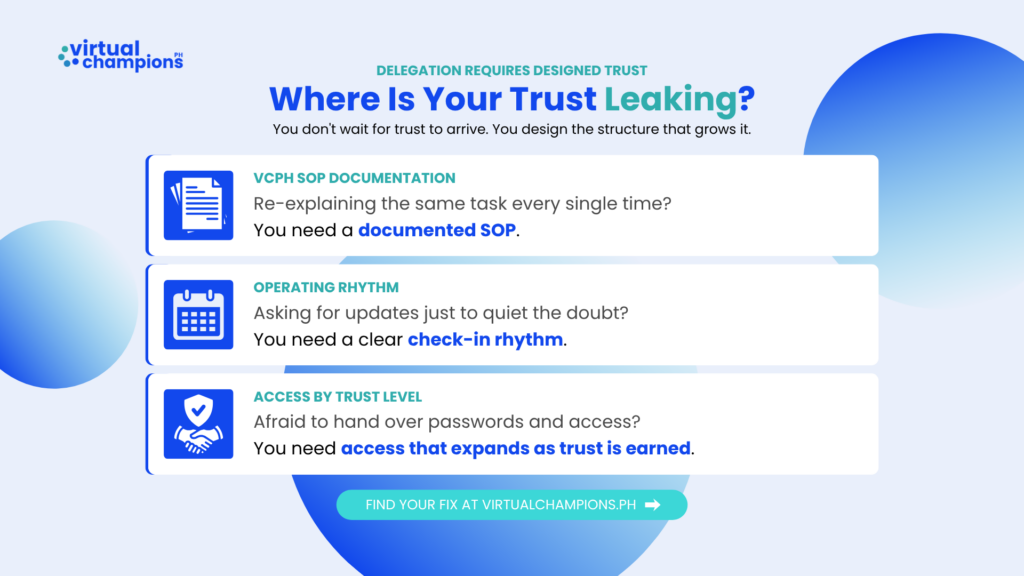
The best first step is understanding where trust is currently leaking.
Is it in the task handoff?
The SOP?
The review process?
The access permissions?
The communication rhythm?
The role clarity?
If you are not sure, we can help you find it.
Book a free discovery call with VCPH, and let us look at where delegation feels heavy, where your trust is getting stuck, and what system should be built first.
Trust was never about being in the same room.
It was always about building something strong enough to carry the work across the distance.
Want to hear the latest news about Virtual Champions PH?
This could be the start of something awesome! Subscribe to our newsletter. Stay updated with exclusive tips, articles, new product tools and notifications, as well as special service offers from VCPH conveniently in your inbox!
